

“I woke up to a 47k bill after deploying ONE Copilot Studio agent!”
-Reddit User [i]
AI Agent Costs Are No Longer Theoretical
On July 31, Microsoft moved Copilot Cowork from a free usage model to a paid model. If your organization is experimenting with agents, connectors, or autonomous workflows, now is the time to ask a practical question: are you prepared for token-related overages to appear on your September bill?
According to KPMG’s June Global AI Pulse Survey[i], nearly half of large organizations have narrowed, delayed, or paused AI agent deployments when costs outweighed the expected value. In many cases, the issue was not the technology itself, it was a lack of visibility into token usage, cost drivers, governance, and operational controls.
Even Microsoft is encouraging internal cost awareness. “As we ramp up our use of GitHub Copilot to achieve our goals, we all need to be mindful of how we consume tokens,” Microsoft Executive Vice President Jay Parikh wrote in an email to employees on August 5, 2026[ii].
A Simple Example: One Research Task Can Scale Quickly
Imagine you need research completed for a quarterly review. You ask Copilot Cowork to analyze a set of current and past documents and spreadsheets, then generate the review. A single run could cost between $5 and $13, (assuming the prompt is correct the first time). Now, multiply that by 20 users, 100 users, or 500 users. Without governance, monitoring, and usage limits, small experiments can become material budget exposure very quickly.
... After that single request, my usage jumped to 622.97 AI Credits ($6.23). Not after a day of usage. Not after dozens of prompts. After ONE request.
-GitHub Community Discussion Thread [iv]
Are You Aware That:
- Microsoft Security Copilot: Billed at $4 per Security Compute Unit (SCU) per hour. You are charged based on the amount of Security Copilot compute capacity you provision. Depending on capacity, this can range from approximately $2,920 to $14,600 per month for 1 to 5 SCUs.
- Copilot Work IQ: If you use a third-party agent grounded in Microsoft 365 data through Work IQ—or build your own—you may pay roughly $0.20 to $1.50 per call, depending on whether the interaction is classified as light, medium, or static.
- Model selection: Choosing Claude/Opus from Anthropic instead of ChatGPT from OpenAI can increase the cost of a Cowork, Agent, Scout, or Work IQ query by an estimated 50% to 70%.
- Runtime choices: Costs can vary based on the model, context window, tools, connectors, and runtime selected for each run.
- Microsoft Scout: Requires an E7 Frontier license at $99 per user per month, plus token costs per run. Lightweight queries may start around $0.16 per run, with higher costs for more complex or repeated interactions.
- PAYG vs. prepaid credits:
- Pay-as-you-go tokens cost approximately $0.01 per credit.
- Prepaid packs may reduce unit cost; for example, a $200 pack for 25,000 credits is approximately $0.008 per credit.
- Prepaid packs are typically “use it or lose it,” meaning unused credits may not roll over to the next month.
Product variability: Costs can vary across products based on the model, context, tools, orchestration, and run complexity.
Governance Questions to Answer Before Costs Escalate
- Budget visibility: Have you enabled cost management alerts so stakeholders are notified before usage reaches budget limits?
- Usage controls: Have you set message and session rate limits to prevent runaway or looping agents?
- Anomaly detection: Are you monitoring for unusual spikes in message consumption, token usage, or agent activity?
- Auditability: Do you regularly review audit logs and analytics for compliance, usage trends, and cost exposure?
- Model governance: Have you restricted which generative AI models and orchestration features agents are allowed to use?
- Access management: Are you using role-based access controls and environment security groups to manage who can build, test, and publish agents?
- Connector control: Have you limited the connectors and actions agents can call to avoid unnecessary or high-cost operations?
- Browser safeguards: Is browser use disabled or restricted to approved sites when running Cowork, especially where browsing could increase cost or risk?
- Pilot validation: Have you run a controlled pilot to measure real consumption before deploying a new agent, connector, or workflow broadly?
- Ongoing reporting: Are you using Microsoft admin tools to track AI usage, activity, and adoption over time?
Unsure how to answer these questions?
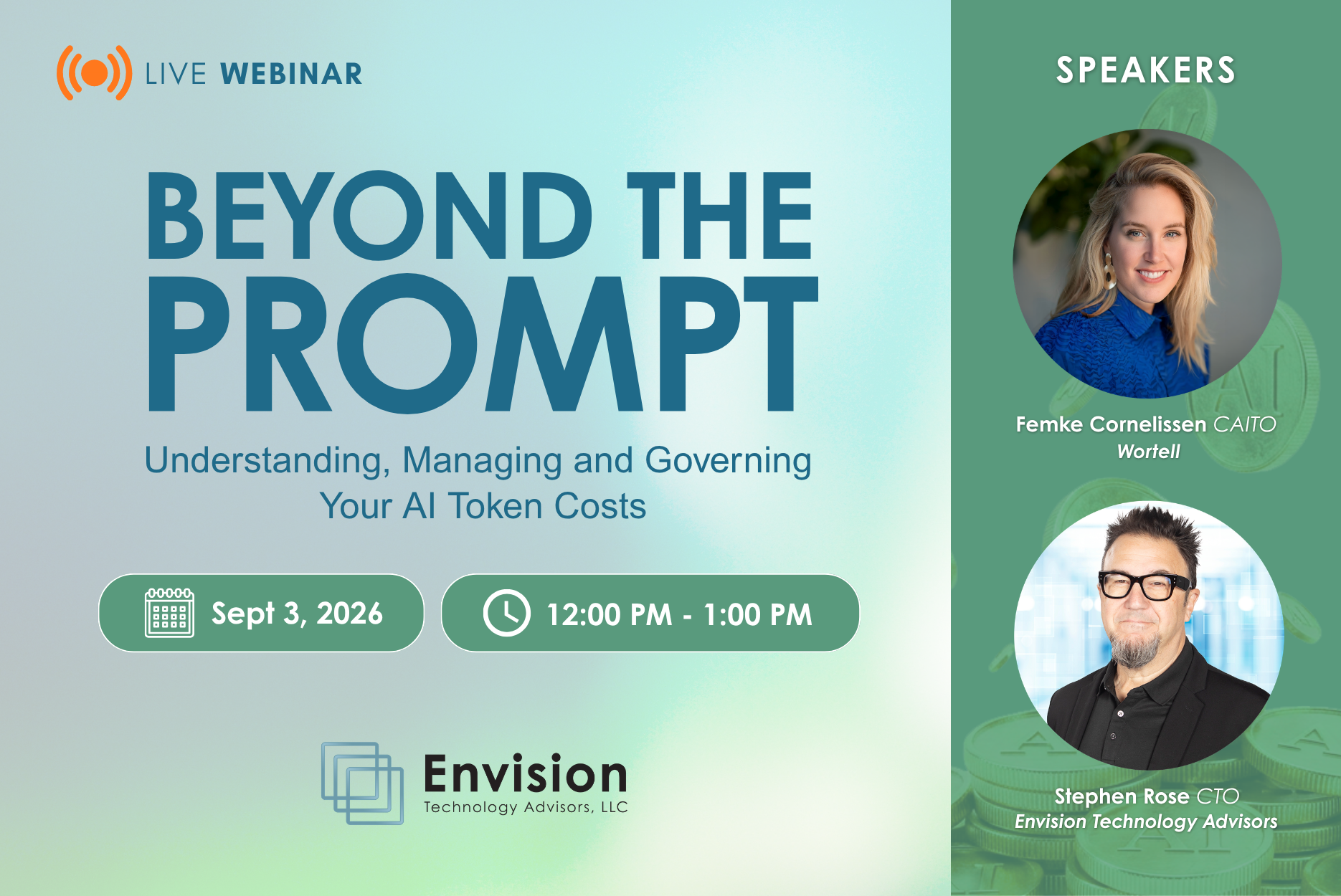
Join Envision's CTO Stephen Rose, a 15-year Microsoft veteran, and Femke Cornelissen, Chief Transformation Officer at Wortell, one of the largest Microsoft partners in the Netherlands, on September 3 for our webinar, “Beyond the Prompt: Understanding, Managing, and Governing Your AI Token Costs.”
During this session, we will demystify token spend across Azure, Copilot Studio, Cowork, Microsoft Security Copilot agents, Work IQ, and Scout. We will also walk through practical ways to govern and lock down these tools so your organization can avoid unexpected costs.
What you will get:
- Clear guidance on how token costs are generated and where overruns typically occur.
- Practical governance steps using tools you already have today.
- Access to a downloadable eBook with additional guidance and recommended next steps.
No sales pitches. No third-party software demos. Just practical information to help you control your AI token costs before they control you.
Click the image below to register today!
About the Author
Stephen Rose is the Chief Technology Officer at Envision. Before joining Envision, he spent 15 years at Microsoft helping some of the world's biggest companies plan, pilot, deploy, manage, secure, and adopt Microsoft technologies. Stephen has spoken at over 150 conferences and continues to do so at conferences around the world. You can follow him across most social platforms @stephenlrose